Monday, November 21, 2016

Astronomy on Tap: Space Robots and Black Hole Jeopardy


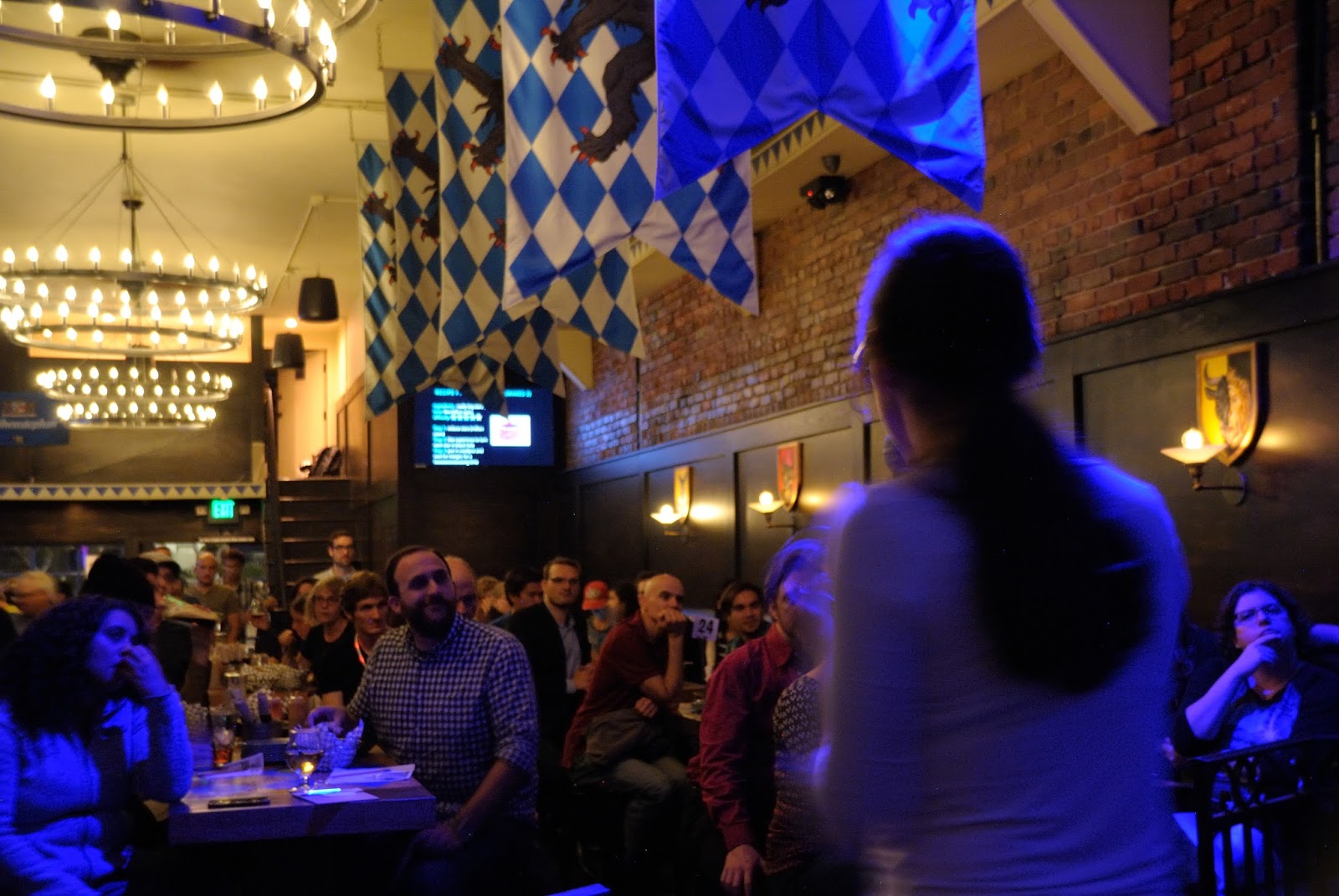
Tonight's Astronomy on Tap event was an exciting one, featuring talks on some very popular topics including the search for life in the universe and black holes!  Attendance was a little light, probably due to this week being the Thanksgiving holiday, but I think all the attendees had a good time regardless.  We started off with a talk by Ricky Nilsson, who discussed the probability that extraterrestrial life may exist, and in what form such life might find itself.  This argument featured the famous Drake Equation detailing the uncertainties in how detecting life, intelligent life, and intelligent life capable of communicating with us over the vast distances of the cosmos.  


Next up was Hannalore Gerling-Dunsmore, who put together a whole game show called "Black Hole Jeopardy" for audience members.  Black hole information sheets were placed around the room over the course of the night, so people could familiarize themselves with information about black holes.  Then three lucky contestants were selected from our audience (professional astronomers were barred from participating).  These contestants played a modification on the popular game: Jeopardy! with black hole-related questions.  While Hannalore's questions were very challenging, even to those of us with formal training in astrophysics, the contestants did pretty well, and they were rewarded with NASA-related prizes like tshirts and pint glasses.  I think everyone learned something about black holes from this event.


Lastly, the astronomy pub quiz had some great questions regarding the space program, cerenkov radiation, and Star Wars.  Everyone got really into it, and the top 2 participants got science prizes from JPL.  Thanks everyone for coming out and see you next month!
--Cameron

Friday, November 4, 2016

Lecture & Stargazing: Great American Eclipse Preparation


Tonight we hosted a lecture by Dr. Erika Hamden, who described how to prepare for the Great American Eclipse.  The Great American Eclipse is a total solar eclipse set to occur next August, where the center line (the strip where the total eclipse will be visible) will stretch across the continental United States.  Erika gave some background on eclipses, what causes them, and what you can see when they happen.  She detailed her experiences having seen one in China in 2008, and pressured everyone to get to somewhere on the center line next summer to catch this one-in-a-lifetime opportunity!

All photographs were taken by Christophe Marcade.


After her lecture, we had a Q&A panel with our local experts answering questions on all sorts of topics ranging from future rocket engine drives to the most interesting and underrated discoveries in the field of astronomy in the last year.


Due to the proximity to Halloween, we invited guests and volunteers alike to show up in their costumes.  I brought Oscar the Grouch along, and several of the attendees showed up in costumes.


Observations went well, and we saw several targets including the first-quarter moon, Mars, and the Double Cluster before the end of the night.  See you again next month!


--Cameron

Saturday, October 22, 2016

Pasadena Astronomy Festival

All photographs were taken by Christophe Marcade.

Today was the Pasadena Astronomy Festival, the final event of Pasadena Astronomy Week at the Pasadena Convention Center.  It was a whole-day event staffed by members of all of the Pasadena-based astronomy institutions: Caltech, JPL, IPAC, Carnegie, Planetary Society, Mt. Wilson Observatory, Thirty Meter Telescope, Giant Magellan Telescope, and KidSpace.  


There were all sorts of activities and booths set up for members of the public to visit and learn about the universe. There was the booth demonstrating how to make a comet with household materials (and dry ice):


The all-terrain Mars Rover that could ride over bumpy surfaces like children:


 A couple of infrared cameras demonstrating how things look in the near-infrared part of the spectrum (primarily by surface temperature):


And our telescopes set up to observe the sun during the day, and astronomical targets at night:


 We had a great time staffing this event, and we hope you had a great time attending.

--Cameron

Wednesday, October 19, 2016

Astronomy on Tap: Dark Matter and Mars-based Meteorites


We had our final Astronomy on Tap event for Pasadena Astronomy Week.  Pasadena Astronomy Week is a series of events showcasing the ways in which Pasadena-based institutions have made important contributions to the field of astronomy and astrophysics.  Tonight's event was packed with people, partially due to the final presidential debate being on the televisions here, and partially due to the LA Dodgers playoff game bringing people in.  Fortunately, the debate ended just as we were set to start, but we left the game on mute on a few of the televisions so as to not incite a riot by baseball fans.

All photographs were taken by Christophe Marcade.

Our first speaker of the night was Dr. James Ashley, a scientists at JPL, who studies meteorites.  He taught us all about meteorites from other planets, and the vast amount of information we can learn about these planetary surfaces and atmosphere from them.  Thanks, James!


Our final speaker of the night was graduate student, Denise Schmitz, who gave us the straight dope on dark matter, what it is, how we know it's there, and how we might be able to learn more about it. It was a really spectacular talk, and everyone enjoyed it.


Thanks to everyone who came out to our events this week, and check out some of the other Pasadena Astronomy Week events through Saturday.  For more photographs from these Astronomy on Tap nights, check out the Pasadena Astronomy Week photo page.

--Cameron

Tuesday, October 18, 2016

Astronomy on Tap: Mount Palomar and Seeing LIGO Detections


All photographs were taken by Christophe Marcade.

Tonight was our second consecutive Astronomy on Tap event for Pasadena Astronomy Week.  Pasadena Astronomy Week is a series of events showcasing the ways in which Pasadena-based institutions have made important contributions to the field of astronomy and astrophysics.  Not only did we have a good turnout of excited members of the public, but Pasadena Mayor Terry Tornek showed up too!  We presented him with a NASA calendar highlighting exoplanetary discoveries made by the astronomical community.


Our two speakers were Caltech astronomers, Dr. Alex Urban and Dr. Eric Bellm talking about their relative fields of study.  Alex discussed how we can use telescopes to try to followup and find the locations of LIGO gravitational wave detections.


Eric talked about the rich heritage of the nearby Palomar Observatory, with some of the ground-breaking discoveries people have used it to make in the last century.  He also discussed how it scientists are continuing to build new instruments for it to continue doing state-of-the-art science today!


Thank you to everyone who showed up.  Come back tomorrow night!

--Cameron


Monday, October 17, 2016

Astronomy on Tap: Twinklin Stars and LIGO Detections


Tonight we helped kick off Pasadena Astronomy Week with our first of three consecutive Astronomy on Tap events.  Pasadena Astronomy Week is a series of events showcasing the ways in which Pasadena-based institutions have made important contributions to the field of astronomy and astrophysics.  And our Astronomy on Tap focused on many of these topics where scientists from Caltech, JPL, IPAC, Carnegie Observatories, and more have had a serious impact on our understanding of the heavens.  Tonight we had two Caltech astronomers, Dr. Ji Wang, and Dr. Astrid Lamberts talking about their relative fields of study.
All photographs were taken by Christophe Marcade.


Astrid talked about the recent LIGO announcement of a gravitational wave detection of two black holes colliding and merging.  She discussed her recent paper wherein she tries to determine the location of the two black holes and what sorts of galaxies these black holes resided.  Very interesting stuff!


Ji talked about his use of adaptive optics to remove the blurriness of images taken from earth-bound telescopes.  Turbulence in the atmosphere between us and distant astronomical objects causes stars to twinkle.  While this is a nice effect for the casual observer, for professional astronomers it introduces blurring in long-exposure images, which makes it difficult to image astronomical objects accurately.  Adaptive optics actually bends and warps a telescope's mirror hundreds of times a second in order to account for the turbulence in the atmosphere, enabling observers like Ji to detect planets around other stars.  Terrific talk, Ji!


Finally, we had a great quiz with lots of participants and some happy winners who got NASA Tshirts and mugs.  Thanks to all of the 130 attendees tonight!

--Cameron

Friday, October 7, 2016

Lecture & Stargazing: Cosmic Explosions through the Ages


Graduate student Jake Jencson taught us about the catastrophic deaths of stars, and the brilliant explosions associated with them: supernovae. After the lecture, IPAC post docs Rahul Patel and Calen Henderson held a Q&A and answered questions on exoplanets, other solar systems in our galaxy, and science fiction.

Outside, we were partially clouded out by drifting clouds. Even so, the over 80 visitors who came to the telescopes got to see the Moon, Mars, and the double star Albireo.

Thank you to the volunteers who helped make the evening such a success, and thank you to the over 120 visitors who attended — we hope to see you all back in a month for Erika's talk on how to prepare for the Great American Eclipse of 2017!

--Anna