Friday, July 8, 2016

Lecture & Stargazing: Simulating the Universe on a Supercomputer


It was a packed house tonight for our lecture featuring Dr. Cameron Hummels explaining how scientists use computers to simulate different astrophysical phenomena.  Cameron described how computers provide us with a means of creating "experiments" inside the virtual space of a computer, where we can control every factor by programming in the physical laws that we want to test.  He provided some simple examples including falling and bouncing balls, planets orbiting the Sun, and then showcased some cutting-edge simulations involving supernovae, galaxy mergers, and the evolution of our Universe as a whole.  Cameron even had a live demo where he logged on to the Blue Waters supercomputer, one of the fastest supercomputers in the world, and showed that it isn't as fancy as you might expect it to be based on its portrayal in movies and television programs.


Photo credit for all images: Christophe Marcade


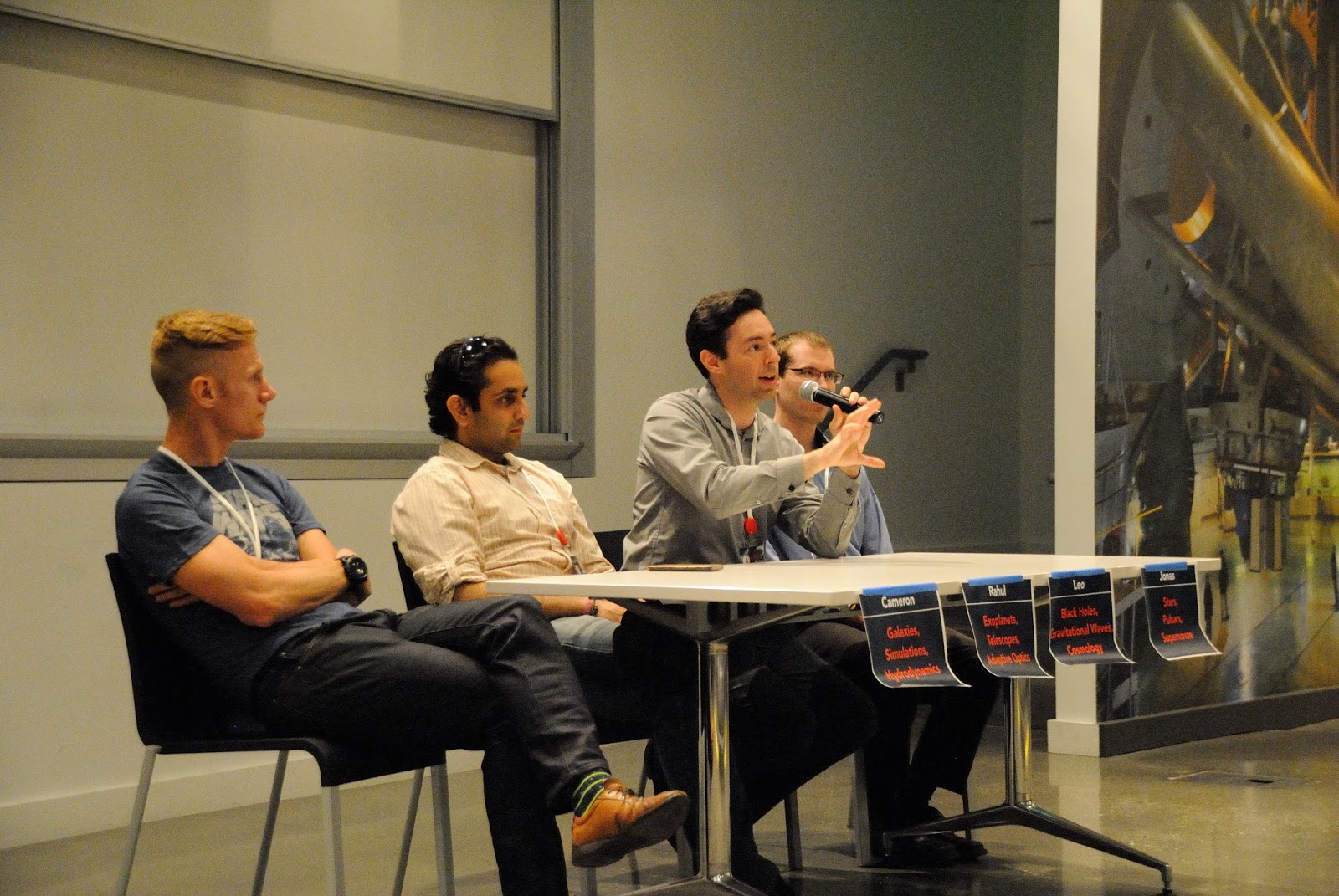
Afterwards, we had a panel Q&A from our experts to answer all of your questions about various fields within astrophysics including the cosmic microwave background, human space flight, and dark matter.  Some excellent discussion was had!


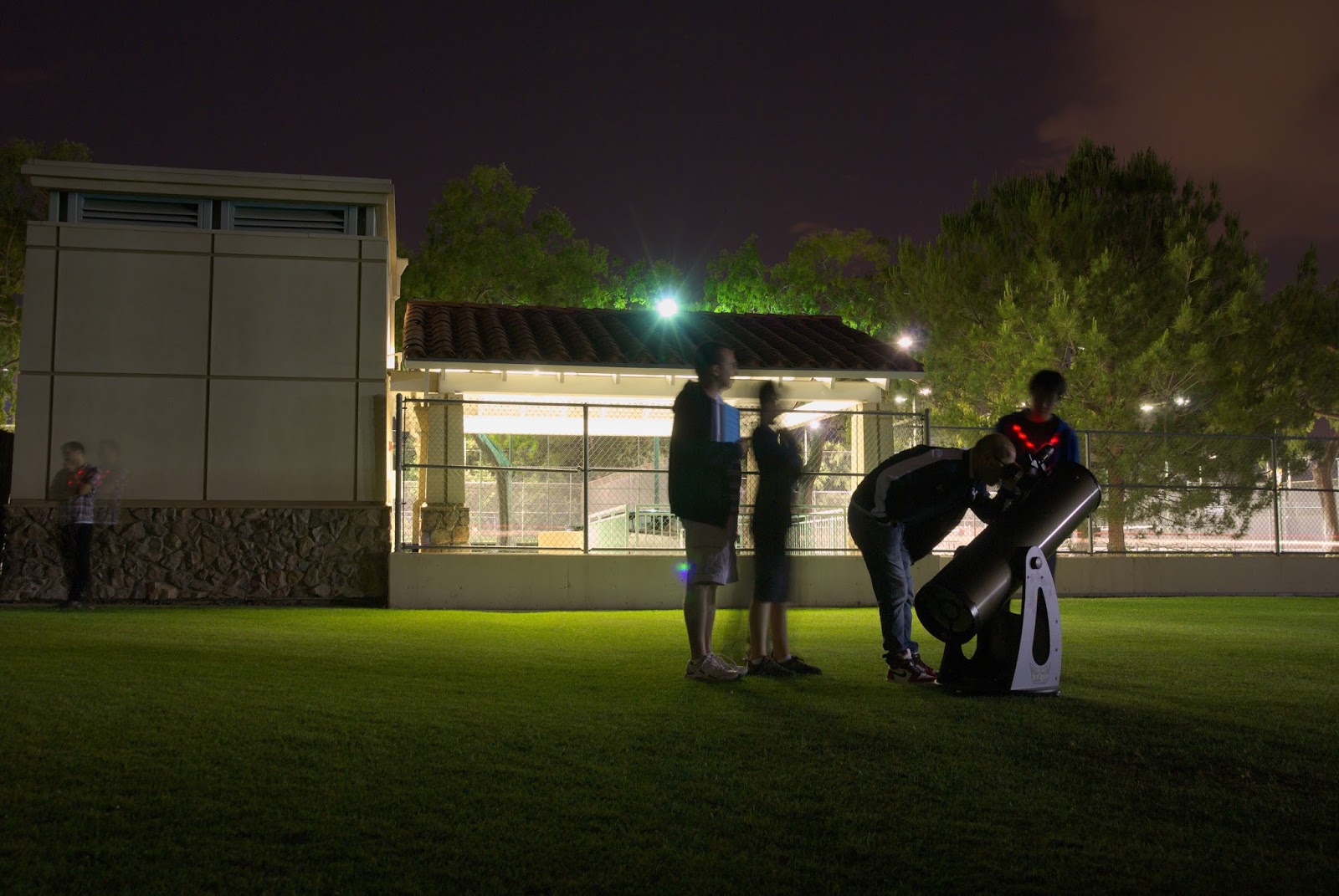
Finally, people joined us on the adjacent field for excellent views of our Solar System and beyond.  We had great views of many of our planetary neighbors including Jupiter, Saturn, Mars, and the Moon.  In between planetary targets, we spent some time looking at the Ring Nebula, a beautiful nearby planetary nebula, and Albireo, a great double star with two very differently colored stars.


The lecture and panel Q&A were recorded, so you can watch them at your leisure on this page.  Thanks to all 150 people who came out tonight, and make sure to come back for our next event, Astronomy on Tap, in two weeks!

--Cameron

Monday, June 20, 2016

Astronomy on Tap: Exoplanet Roulette


Tonight we had our very first ever Astronomy on Tap event held in Los Angeles, and it was a wild success!  Astronomy on Tap is a nation-wide phenomenon where professional astronomers give informal talks in local bars on a variety of scientific topics followed by lots of discussion and interaction with the public.  Until now, there have been no organized events happening in Los Angeles, but we at Caltech are partnering with several other neighboring educational institutions to make this happen.


We held our first event at Der Wolfskopf, a german beer bar located in Old Town Pasadena gracious enough to offer us happy hour prices all night on food and on one of their beers.  The event was structured to have two short astronomically-themed talks with 15-minute intermission periods separating them.  During each intermission, audience members were encouraged to talk to the astronomers present in addition to playing our astronomy quiz that was being broadcast on the television sets.


Dr. Jessie Christiansen gave our talk for the night entitled "Exoplanet Roulette: Choose your Fate".  The premise is that you have the opportunity to travel to some exoplanet in the Universe, but you don't know which one.  By spinning the game wheel, you discover which exoplanet where you'll end up.


A couple of the exoplanets were happy endings for our audience members, but by and large the bulk of the exoplanets that have thus far been discovered are not very hospitable to human life.


Unfortunately, our second speaker had an emergency and wasn't able to join us.  We had a short panel Q&A with the variety of astronomers present, where prizes were awarded for particularly good questions from the audience.  Lastly, we finished the night by grading the trivia quizzes that people had submitted.  There was a three-way tie with 8/10 correct, and each winner won a prize of a NASA shirt or mug.  Congratulations to all of our winners!


Thanks to all 70 of the attendees and we hope you'll spread the word about our next event in a month on Monday, July 25 at 7:30PM.

--Cameron

Friday, June 10, 2016

Lecture & Stargazing: Black Holes Don't Suck


During tonight's lecture, Chiara Mingarelli taught us all about black holes: why they are black, how they interact with their environments, and the various ways astronomers can detect them.  Importantly, she broke down the common misconception of black holes acting as vacuum cleaners, and conclusively demonstrated that black holes *don't* suck, they just act like any other concentration of mass.

Photo credit for all images: Christophe Marcade


After the lecture, we had some stargazing with the telescopes outside.  Despite the somewhat patchy clouds present, we were still able to see many of the planetary highlights in the sky, including Jupiter, Saturn, Mars, and the Moon.


We also had a Q&A panel from some of our resident experts on a variety of topics including supernovae, exoplanets, gravitational waves, and galaxies.  There were a host of questions regarding cosmology and gravitational waves, but we had some good discussions on subject spanning all of astrophysics and space exploration.  


If you wish to see a recording of the lecture and subsequent Q&A panel, you can view them here.  Thanks to the hundred or so people who turned up!

--Cameron


Friday, May 13, 2016

Lecture & Stargazing: The Planetary Atmospheres of the Solar System


Did you ever wonder why our Earth has the air that it has, and none of the other planets in the Solar System have an atmosphere quite like it?  These were the questions that Jackie Villadsen addressed in her talk entitled: "The Air We (Can't) Breathe: A History of Air on Venus, Earth, and Mars".  Jackie did a remarkable job explaining how and why Venus and Mars lack the sort of atmosphere we have on Earth, due to their different masses, gravitational pull, and magnetic fields.  She also illustrated how certain signatures might enable us to identify other planets hosting life the same way Earth does.
Photo Credit for all Images: Michael Wong


After Jackie's talk, our visitors joined us for stargazing out on the adjacent fields with our telescopes.
The weather was a little hazy, so observing deep sky objects was challenging, but we were still able to get some great views of the first-quarter Moon as well as Jupiter and its largest moons.


For those who stayed in the lecture hall, we held a panel to answer visitor's questions on a variety of science topics, ranging from the possibility of interstellar travel, the viability of worm holes, the nature of dark matter, and planetary magnetic fields.  It was a great discussion!


If you missed any of the talk or Q&A panel, please watch our recording here.  The talk begins at 5:50, and the panel Q&A begins at 1:04:30.  Thanks to all 120 attendees for coming, and remember to join us next month for a talk about black holes by Chiara Mingarelli!

--Cameron

Friday, April 15, 2016

Lecture & Stargazing: Telescopes at the South Pole


One of our goals in holding these events is to share our experiences of what it’s like to be a scientist. Last night, postdoctoral fellow Abby Crites showed a picture of herself in the plane that scientists take to get to the South Pole. She talked not only about why the South Pole is such a great environment for studying the most distant light in the universe, but also about her personal experiences living down there to build a telescope.

Photo Credit for all Images: Christophe Marcade
  
After the talk, the event continued in two spaces. Outside, our telescope volunteers (led by the fearless Mislav) took advantage of the clear weather to show visitors a whole suite of objects, ranging from the moon to Jupiter to a nearby group of stars called the Beehive cluster. We even saw the International Space Station pass overhead, before it faded away behind the Earth’s shadow. 


Inside, we held an informal Q&A panel of graduate students and postdocs. From Abby’s talk, our visitors seemed to have cosmology on the mind — there were a number of questions about the cosmic microwave background and the early universe. We also talked about scientific accuracy in movies, the recently unveiled plan to send a spacecraft to Alpha Centauri, and our own galaxy, the Milky Way. 


As usual, the lecture and Q&A was recorded and you can watch them here. The lecture begins at 03:53, and the panel discussion starts at 43:25.

Thank you to the volunteers who helped make the evening such a success, and thank you to the over 80 visitors who attended — we hope to see you all back in a month for Jackie's talk on the history of air on Venus, Earth, and Mars!

--Anna

Friday, March 18, 2016

Lecture and Stargazing Event with Talk by Sebastian Pineda

Graduate Student Sebastian Pineda kicked off another great public night with a lecture on The Northern Lights on Earth and other planets in the Solar System.  Not only did it include spectacular footage of this beautiful phenomenon, but Sebastian provided a scientific explanation for what causes the aurora on the Earth, and how it differs on other planets.  For instance, while the aurora on most planets is due to interactions between its magnetic field funneling solar wind particles down into its atmosphere, Jupiter's aurora is also caused by plasma emitted from its nearest moons like Io and Europa impacting the outer layers of the gas giant.

Photo Credit for all Images: Christophe Marcade


After the talk, attendees were invited to look through our telescopes at the highlights of the spring sky, including the Orion Nebula, a first-quarter Moon, and Jupiter and its Galilean Moons.  The weather was clear, so everyone had a good view of the heavens.


Finally, we had a panel of scientists from the department on hand to answer questions regarding any astronomical topic the audience members wished.  Our panelists were Swarnima Manohar, Gina Duggan, Abby Crites, Drew Clausen, and myself.  We discussed black holes, cosmology, exoplanets, magnetic fields, radio-isotopes used as energy sources for spacecraft, and more.  It was really fun, so be sure to show up next time with more questions for our panel!


Just like last month, we recorded the whole event, so you're welcome to watch it at your leisure by clicking here.  The lecture begins at minute 4:00, and the panel discussion begins at 51:15.  Unfortunately, we had some technical problems with the camera, so it was unable to pick up video for the panel discussion, but there is audio at this point.  We will address this prior to our next event.

Thanks to the over 100 people who attended.  See you in a month!

--Cameron

Friday, February 19, 2016

First Lecture and Stargazing Event with Talk by Dr. Evan Kirby

Photo Credit for all Images: Christophe Marcade
Tonight we hosted our first event, officially kicking off our inaugural stargazing and public lecture series.  Professor Evan Kirby spoke to a room of 90 attendees about how he and other scientists use the Keck telescopes to study how dwarf galaxies evolve over time.  Utilizing spectrographic instruments to break starlight into its component colors, he is able to determine the chemical makeup of the stars inside these dwarf galaxies.  Once scientists know the chemical makeup of these stars, they can deduce how and when the stars formed to produce the galaxy as we see it today.


After the lecture, attendees were invited to look through our telescopes at the various objects visible that night including the Orion Nebula, the Pleiades, and the Moon.  Later in the night, Jupiter rose and we were able to see all four of its Galilean Moons!


Finally, we hosted an informal panel made up of three specialists from the field of gravitational wave astronomy.  Dr. Jamie Rollins, Dr. Chiara Mingarelli, and Dr. Leo Stein answered questions about the LIGO gravitational wave discovery last week providing some insight behind the announcement.  It was a lively discussion for over an hour about what the discovery means, and what it tells us about the Universe around us.


The entire event was recorded and is available to watch on your computer--go to this link.  To skip the announcement and deadtime, you can jump to the lecture beginning at minute 7:48, and the gravitational wave panel discussion beginning at minute 52:00.  We will be recording all of our lectures from now on, so you never have to miss an event!

Thanks to everyone who came out.  We're looking forward to a great year!

--Cameron