Monday, October 17, 2016

Astronomy on Tap: Twinklin Stars and LIGO Detections


Tonight we helped kick off Pasadena Astronomy Week with our first of three consecutive Astronomy on Tap events.  Pasadena Astronomy Week is a series of events showcasing the ways in which Pasadena-based institutions have made important contributions to the field of astronomy and astrophysics.  And our Astronomy on Tap focused on many of these topics where scientists from Caltech, JPL, IPAC, Carnegie Observatories, and more have had a serious impact on our understanding of the heavens.  Tonight we had two Caltech astronomers, Dr. Ji Wang, and Dr. Astrid Lamberts talking about their relative fields of study.
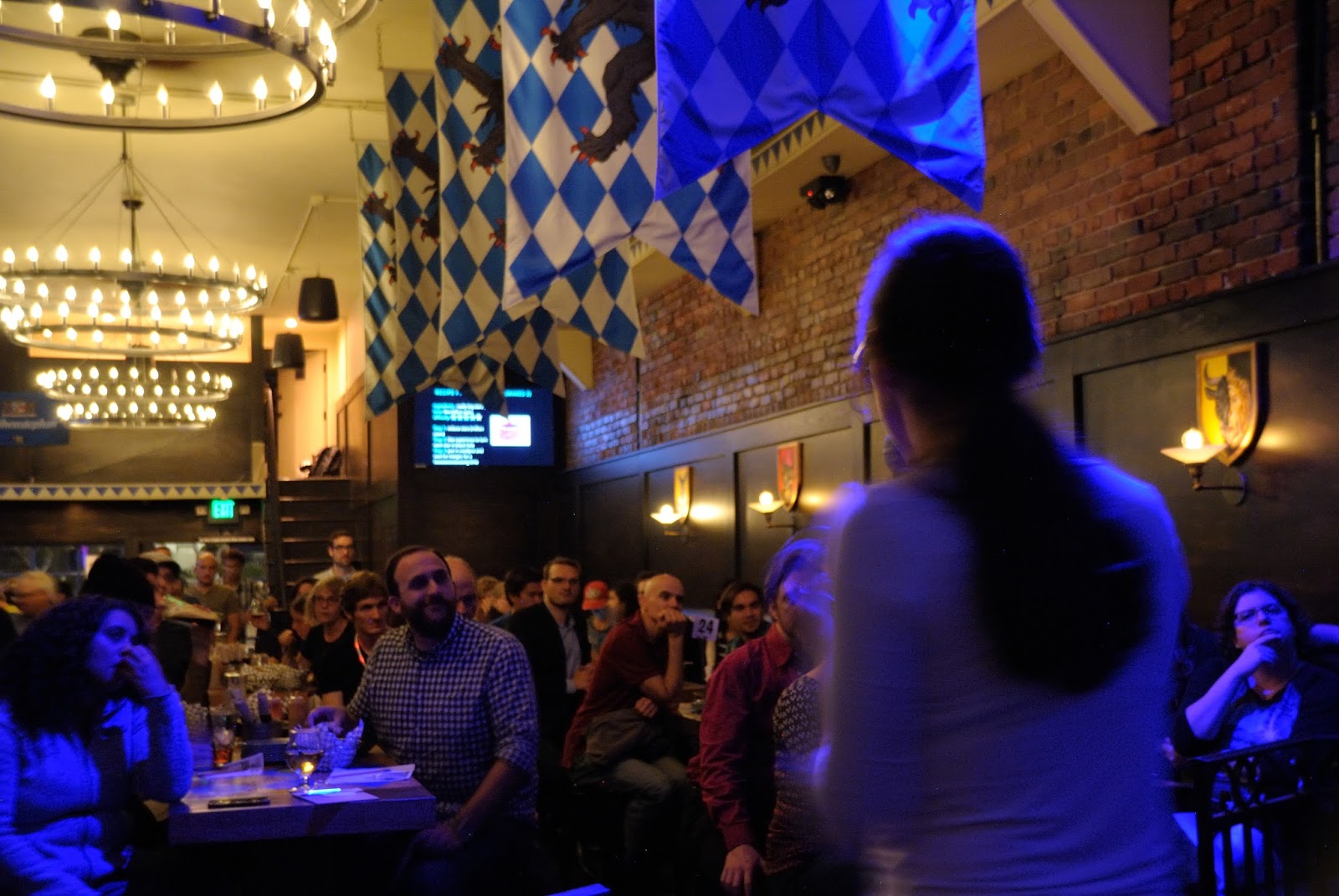
All photographs were taken by Christophe Marcade.


Astrid talked about the recent LIGO announcement of a gravitational wave detection of two black holes colliding and merging.  She discussed her recent paper wherein she tries to determine the location of the two black holes and what sorts of galaxies these black holes resided.  Very interesting stuff!


Ji talked about his use of adaptive optics to remove the blurriness of images taken from earth-bound telescopes.  Turbulence in the atmosphere between us and distant astronomical objects causes stars to twinkle.  While this is a nice effect for the casual observer, for professional astronomers it introduces blurring in long-exposure images, which makes it difficult to image astronomical objects accurately.  Adaptive optics actually bends and warps a telescope's mirror hundreds of times a second in order to account for the turbulence in the atmosphere, enabling observers like Ji to detect planets around other stars.  Terrific talk, Ji!


Finally, we had a great quiz with lots of participants and some happy winners who got NASA Tshirts and mugs.  Thanks to all of the 130 attendees tonight!

--Cameron

Friday, October 7, 2016

Lecture & Stargazing: Cosmic Explosions through the Ages


Graduate student Jake Jencson taught us about the catastrophic deaths of stars, and the brilliant explosions associated with them: supernovae. After the lecture, IPAC post docs Rahul Patel and Calen Henderson held a Q&A and answered questions on exoplanets, other solar systems in our galaxy, and science fiction.

Outside, we were partially clouded out by drifting clouds. Even so, the over 80 visitors who came to the telescopes got to see the Moon, Mars, and the double star Albireo.

Thank you to the volunteers who helped make the evening such a success, and thank you to the over 120 visitors who attended — we hope to see you all back in a month for Erika's talk on how to prepare for the Great American Eclipse of 2017!

--Anna

Monday, September 26, 2016

Astronomy on Tap: Supernovae and the Big Bang


The September 2016 Astro on Tap in Pasadena at Der Wolfskopff pub had an interesting start, as many of the audience members were mesmerized by the first Presidential debate. But after we decided to turn off the debates and start the session, the mood in the bar was lifted dramatically. We started off with Dr. Ragnild Lunan, a postdoc at Caltech, talking about "Spectacular Stellar Explosions" and the science of supernovae and old stars that eventually die off in spectacular explosions!

All photographs were taken by Christophe Marcade.


Our second talk was given by Dr. Andreas Faisst, a postdoc at IPAC/Caltech. Andreas talked about the early Universe, and detailed the evolution from The Big Bang all the way to the first galaxies with some amazing videos and balloon props!


We also had a lot of people participate in our astro trivia challenge. After a difficult selection, we gave away a few prizes including a NASA mug, t-shirt and exoplanet poster! All in all, it was a great positive night, despite the looming debate earlier in the night.

--Rahul

Friday, September 9, 2016

Lecture & Stargazing: The Invisible Universe Revealed


All photographs were taken by Christophe Marcade.

Tonight was our first night in a new location for our lecture series.  Due to some construction issues, we've now moved our lectures to Baxter Lecture Hall and our stargazing to Beckman Lawn (see our directions page for more info).  After some logistical issues we got started a few minutes late.  Anna Ho, our speaker for the night, gave a tremendous talk on the invisible universe, the universe we cannot directly perceive with our eyes.  

Anna described the various wavelengths of light in the electromagnetic spectrum, and how our eyes are only capable of viewing a very small fraction of them.  She described what sort of devices you have to create in order to "see" these other wavelengths of light, and what sort of objects you can then "see" like distance galaxies or the dust in between stars.  It was riveting!


After Anna's talk, the audience was welcome to stargaze out on the Beckman Lawn with our telescopes, or remain for a panel Q&A with our panel of experts.  Our panel consisted of Dr. Katherine Deck, Graduate Student Mike Wong, Dr. Anders Thygesen, and Dr. Cameron Hummels.  We had a great time talking with each other and our small audience.  


Stargazing out on the lawn was also pretty successful, and it looks like our new spot has less light pollution than the North Field.  We observed Albireo, Saturn, Mars, and the Moon.  Thanks to all 70 people who showed up at our new location!  We hope to see you again next month.

--Cameron

Monday, August 22, 2016

Astronomy on Tap: Edwin Hubble and Earth-like Planets


We hosted another Astronomy on Tap event at Der Wolfskopf Pub tonight, and everyone had a great time.  We started the night with a stellar talk by Dr. Marja Seidel, a postdoc at the Carnegie Institute in Pasadena. Marja's talk was entitled "Galaxies with Edwin", and it was a comic-style presentation telling the story of how Edwin Hubble (and Henrietta Leavitt) discovered that our Milky Way galaxy was not the entirety of the Universe.  It was a great topic and a really innovative manner of presenting!


Next up, Dr. Calen Henderson, a postdoc at the Jet Propulsion Laboratory, gave us a compelling presentation on the search for Earth-like planets in the Universe.  His talk "Earth through the Looking Glass" discussed why we search for Earth analogs, how we do it, and what are the prospects for finding life elsewhere in the Universe.  It's very relevant information, especially with the recent discovery of an Earth analog in our neighborhood at Proxima Centaur B.


We had several winners of our astronomical-themed pub quiz with some NASA shirts and hats as prizes.  Congratulations to all of the participants!  We look forward to seeing everyone next month!

--Cameron

Friday, August 12, 2016

Lecture & Stargazing: You Can't Spell Exoplanets without Ex(ecutions)


It was another busy night in Cahill for our lecture and stargazing. First up was Jessie Christiansen, talking about the existing history and study of extra-solar planets. Jessie first went through the (surprisingly!) long history of the idea of planets beyond our own solar system. As early as the middle ages, scientists thought about planets around other stars (usually with bad results!). But in the last twenty years, exoplanets have gone from being dismissed or ignored by astronomers to a vibrant field of study with thousands of detected planets. Jessie also discussed the efforts of the Kepler telescope, which has provided thousands of planet detections on its own. Jessie finished by describing some of the more incredible planets we've found- including one with liquid glass rain, some new baby planets, and others! 


After the lecture, Erika Hamden gave a short presentation on the Perseid meteor shower, which peaked the night before. Unfortunately for our star gazers, the best time to see the shower was later in the night (when our wonderful telescope volunteers would be long gone), but Erika encouraged everyone to get to dark sky sights to see other meteor showers in the future.

Lastly, we had a great Q&A panel, discussing planets, life in the universe, telescopes, and black holes. A fabulous evening for all!

On the stargazing front, three telescopes observed Mars, Saturn, and the Moon to start, before switching over to other dark sky targets later in the night. Some of our attendees looked studiously for meteors, but there were only a few sightings so early in the night. This will be our last star gazing from the north field for a few months, while the athletic department installs a turf field. Be on the look out for information on our new location for the next few months!

--Erika

Monday, July 25, 2016

Astronomy on Tap: Jupiter and Beer in Space


We had our second Astronomy on Tap event tonight, and it was a packed house.  A few days earlier, LA Weekly had featured us as a fun activity to do in LA this week, and thus we ended up with over 110 people filling up our venue, Der Wolfskopf Pub.

We started the night with a great talk by Dr. Rachael Beaton, a postdoc at the Carnegie Institute in Pasadena. Rachael's talk was entitled "The First Beer Came from Space", and it covered how and why different types of atoms and molecules, form in the cores of stars and in the clouds of gas in the far reaches of space.  Even our favorite molecule, alcohol, can form in these systems. Rather than sending up space craft to mine rare metals in asteroids, she suggested we might mine the quadrillions of gallons of alcohol in these clouds.


We had an intermission where the audience could interact with the various astronomers present in the audience, and we had astronomy-themed quiz questions flash across the television monitors.  After about 20 minutes, our second talk was given by Dr. Rahul Patel from NASA's IPAC facility in Pasadena. Rahul spoke about the recent Juno mission that NASA launched to Jupiter, what its goals were, and what we can learn from it.  


After another intermission period, several of our local experts got up to answer audience questions on a variety of astrophysical topics including galaxies, black holes, and more.  Finally, we graded the quiz questions and went through them together.  Our winner received a signed copy of Caltech Astrophysicist Dr. Kip Thorne's book: "The Physics of Interstellar".


Thanks to everyone who attended, and thanks to Der Wolfskopf for hosting us!  See you in a month!

--Cameron